|
| RIGA -
Sarkana Zvaigzne - LATVIJA. ● (RYSSLAND -
RUSSIA - РОССИЯ.) |
• Soviet
Union. |
^ back to Back
- to AZ reg. |
|
|
- -
- -
- -
- -
- - -
- - |
|
Latvia - Latvija - Lettland. |
 |
|
|
|
|
Riga Motor Plant (RMP)
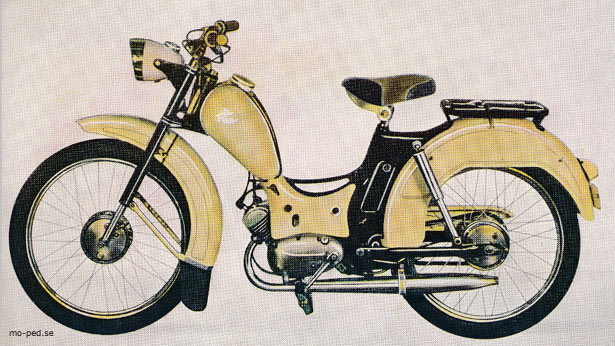
• Moped "Spiriditis" (1958) engine 60 cm3
• Motorbike "Gauja" (1961-1963)
..................
• Moped "Riga-1" (1961-1965)
.....................
• Moped "Riga-3" (1965-1969)
.....................
• Moped "Riga-4" (1970-1974)
• Moped "Riga-6"
• Easy moped "Riga-5" (1966-1975)
............
• Easy moped "Riga-7" (1975 -)
...................
• Easy moped "Riga-11"
..............................
• Moped "Riga-12" (1974-1979)
• Easy moped "Riga-13"
..............................
• Moped "Riga-14"
• Moped "Riga-16" (1979-1984)
...................
• Moped "Riga-22" (1984-1986)
...................
• Moped "Riga-24" RMZ-2.124 (1986-
• Mini mokik "Mini" RMZ-2.126
without
rear shock absorbers (1984-)
• Mini mokik "Mini" RMZ-2.130 (1986-
• mokiki "Delta" RMZ-2.134 (RMZ-2.134-01)
• mokiki "Mini Delta"
• mokiki "Stella" RMZ-2.136
........................
|
MOTOR:
•
• D4, D5.
• Riga-1, Jawa-552. ............
• Riga-3, W-51.
•
•
• Riga-5, D-5.
.....................
• Riga-7, D-6.
.....................
• Riga-11, D-6.
...................
•
• Riga-13, D-8. ..................
•
•
Riga-16, W-58. ................
• Riga-22. W-62 eller V50.
•
•
•
•
•
•
•
.......................................
• Riga-26/30, V50 och V501
|
Рижский мотозавод (РМЗ)
• Мопед "Спиридитис" (1958 г.) с
двигателем 60 см3
• Мотовелосипед «Гауя» (1961-1963)
• Мопед «Рига-1» (1961-1965)
• Мопед «Рига-3» (1965-1969)
• Мопед «Рига-4» (1970-1974)
• Мопед «Рига-6»
• Легкий мопед «Рига-5» (1966-1975)
• Легкий мопед
«Рига-7» (1975-)
• Легкий мопед «Рига-11»
• Мопед «Рига-12» (1974-1979)
• Легкий мопед «Рига-13»
• Мопед «Рига-14»
• Мопед «Рига-16» (1979-1984)
• Мопед «Рига-22» (1984-1986)
• Мопед "Рига-24" РМЗ-2.124 (1986-
• Мини-мокик "Мини" РМЗ-2.126
без задних
амортизаторов (1984-
• Мини-мокик "Мини" РМЗ-2.130 (1986-
• Мокик «Дельта» РМЗ-2.134 (РМЗ-2.134-01)
• Мокик "Мини Дельта"
• Мокик "Стелла" РМЗ-2.136
|

|
|
 |
|
N1 |
Links |
|
|
|
 |
|
N2
|
|
| |
Riga 1.
Bj. (Bj.61-65)
Motor: Jawa 522
|
Riga 1. EXPORT
to Finland.
Motor: Jawa 522
|
Riga 1.
Motor: Jawa 522
|
|
|
|
|
|
N3
|
 |
| |
Riga 3.
Motor: W-51.
|
Riga 3.
|
Riga 3.
|
 |
|
|
|
|
N4 |
 |
|
|
 |
|
N5 |
 |
|
|
|
|
|
N6 |
 |
| |
Riga
12.
|
AVTOEXPORT
MOSCOW USSR |
|
|
|
|
|
|
|
 |
|
1958 |
Spiriditis
|
Radmarkt 23/58 |
• Wieviele Radwege führen durch Europa?
 |
|
|
|
|
|
|
 |
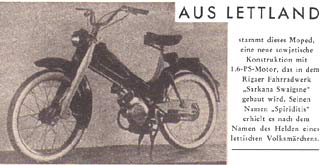
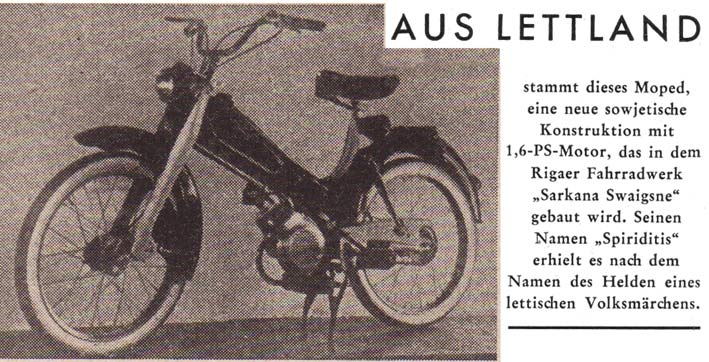
FROM LATVIA
comes this moped, a new Soviet
construction with 1.6 HP engine, which is built in the Riga
bicycle factory "Sarkana Swaigsne".
It got its name "Spiriditis" after
the name of the hero of a Latvian folk tale. |
|
|
|
|
|
|
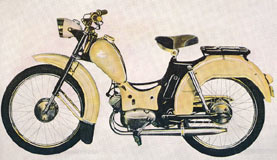
Moped model "Spriditis" (sometimes
spelled Spiriditis), which was the very first moped prototype
from the Latvian factory Sarkana Zvaigzne (Red Star) in Riga.
"Spriditis" was developed in 1958 in the then Latvian SSR as a
response to the need for a new, lightweight means of transport
that combined the features of both motorcycles and bicycles.
"Spriditis" is the name of the
hero (equivalent to "Thumbelina") in a famous Latvian folk tale
written by Anna Brigadere.
"Spriditis" was equipped with a
1.6 hp engine and had an engine displacement of 60 cm³. It
weighed about 45 kg and retained pedals so that it could be used
as a bicycle if necessary. The Spriditis was an experimental
model. The experience from this later led to the development of
the more successful and mass-produced Riga-1, which began
production around 1960–1961.
The Sarkana Zvaigzne factory later
became one of the largest moped manufacturers in the Soviet
Union, producing the famous "Riga" series until the late 1990s. |
|
|
|
|
|
|
 |
|
|
 |
|
1961-63 |
Riga-2 "Gauja" |
|
 |
|
|
|
|
|
|
|
|
|
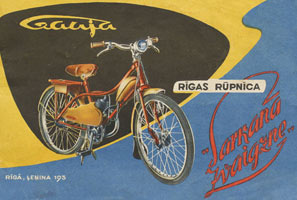
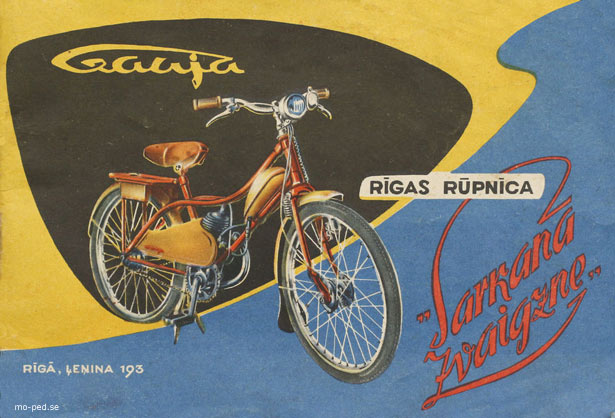
Rīgas Rūpnīca (Riga Motorcycle
Factory) in Latvia.
The Gauja, also known as
Riga-2, was manufactured between 1961 and 1966 (1963?).
It was the first mass-produced
motorized bicycle from the Riga factory. It had a rigid tubular
frame, a bicycle-type pedal mechanism, and a pendulum front fork
with spring shock absorbers. It was equipped with a
single-cylinder two-stroke engine (models D-4 or D-5)
of about 1 horsepower.
Factory "Sarkana Zvaigzne" the
name means "Red Star" in Latvian. The factory was located at
Lenina 193 in Riga, which is also visible at the bottom left of
the picture. Originally it was the Gustavs Ērenpreiss bicycle
factory (founded in 1927), but it was nationalized in 1940 after
the Soviet occupation of Latvia. During its heyday, it was the
largest moped manufacturer in the Soviet Union. The factory
finally closed in 1998 after demand dropped dramatically after
Latvia's independence. |
|
|
|
|
|
|
 |
|
|
 |
|
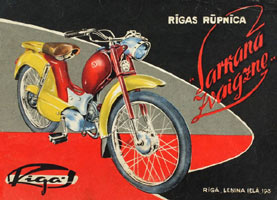
1961-65 |
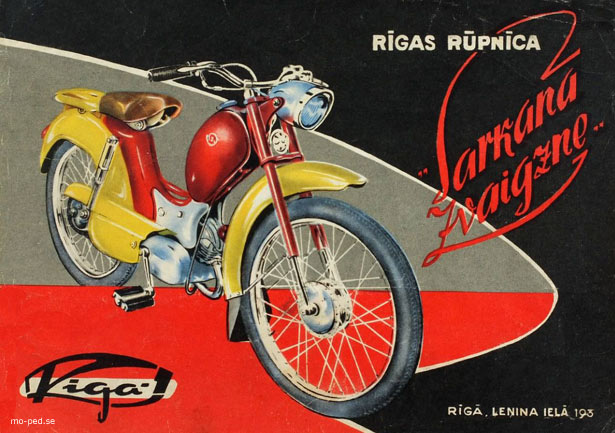
Riga-1.
|
|
 |
|
|
|
|
 |
Motorized bicycles and mopeds are
the simplest, most comfortable, and
most economical motor vehicles.
Buy and ride Soviet motorized
bicycles!
The "Riga-1" moped is suitable for
business and private use, as well as for
long-distance journeys in all
climatic and road conditions.
Soft suspension of the wheels and
good protection against road wear give
the moped exceptional riding
comfort both in city traffic and on long journeys.
Operating the moped is simple and
easily mastered by beginners.
The powerful engine and two-speed
gearbox make it possible to develop
high speeds and conquer
significant inclines.
|
|
|
|
|
TECHNICAL DATA
1. Chassis
Frame.............................Tubular
frame
Front fork......................Telescopic
fork
Rear suspension...Swing fork with
shock absorber
Tires............................
23 x 2.25"
Overall dimensions, mm:
Length....1800
Width
(at handlebars)...750
Height......900
Weight, kg...................45
Load capacity,
kg.........................120
Top speed,
km/h........................... 40
|
2. Engine Jawa 552
Engine type....................Two-stroke
engine
Displacement,
cm³.....................49.8
Power at 4250 rpm, hp...............
1.5
Max. engine speed,
rpm.............. 6000
Transmission ............Two-speed
transmission
Fuel.........Gasoline/oil mixture
1:25
Fuel consumption per 100 km km,
l......... 1.6
Fuel tank capacity,
l............................. 6
3. Electrical Equipment
Fly-on magneto ignition:
Lighting coil power, W13
Voltage, V6
Headlight.....with dual-filament
bulb (for high and low beam) 15 + 15 HK
Horn ...................AC signal |
The streamlined shape and vibrant
enamel finish give the moped an
appealing appearance.
In rigorous testing, the "Riga-1"
mopeds demonstrated outstanding
performance and fuel efficiency.
Excellent design, premium
materials, and meticulous manufacturing ensure
the mopeds' reliable operation and
long service life.
|
|
|
|
|
|
|
 |
|
|
 |
 |
|
Back to [Konela Oy] Finland. |
 |
|
|
|
|
|
Riga-1 Fördelar: Utmärkt
prestanda, Lång livslängd, Utmärkta köregenskaper, Fördelaktigt
pris Pris: 530:- fritt i Helsingfors
Beskrivning: Riga-1 är en ny
intressant bekantskap för alla mopedvänner. Dess hållbara och
segdragande tvåtaktsmotor utvecklar tillräckligt med kraft för
körning under alla förhållanden. Rejäl däckstorlek och utmärkt
fjädring garanterar en jämn och flexibel gång såväl i
stadstrafik som på landsbygden. Bekväm och välfjädrad sadel gör
körningen bekväm även på långa sträckor. Garanti: 5000 km eller
ett år för ram och motor. Garantin gäller tillverknings- och
råvarufel.
|
|
|
|
|
 |
|
Importör: Konela, Helsingfors-Drumsö |
|
|
 |
|
|
 |
|
1961-65 |
Riga-1.
|
|
 |
|
|
|
|
|
|
|
|
|
Riga-1, the first mass-produced
two-speed moped from the legendary Latvian factory Sarkanā
Zvaigzne (Red Star) in Riga.
The Riga-1 began mass production
in 1961 after extensive testing, with prototypes driven over
10,000 km in 50 days across large parts of the then Soviet
Union. The factory, originally the Gustavs Ērenpreis bicycle
factory, became the largest moped manufacturer in the region
during the Soviet era.
The earliest models of the Riga-1
used engines from the Czechoslovakian Jawa (model 552), which
contributed to the moped's popularity due to their reliability.
Engine is a 1-cylinder, 49.8 cc
Jawa 552 cirka 1.5 to 1.6 horsepower.
Top speed: 40 km/h. Weight: 45 kg.
Transmission: 2 gears with manual transmission |
|
|
|
|
 |
|
|
 |
|
|
|
|
 |
|
|
MOTOR:
Riga-1, Jawa-552. • Riga-3, W-51.
• Riga-5, D-5. • Riga-7, D-6. • Riga-11, D-6. Riga-13, D-8. •
Riga-16, W-58. • Riga-22. W-62 eller V50.
• Riga-26/30, V50 och V501 |
|
|
|
|
|
|
 |
|
|
 |
 |
RIGA 3 |
|
 |
|
|
|
|
|
 |
|
|
In 1967 the successor, Riga-3, was
presented at the Budapest International Fair. It was not much
different from its predecessor, however, some changes were done
to be able to use the S-51 engine. It was a 49.8 cc, air cooled,
1.5 HP engine using carburetor, mostly of type K30 or K35. It
had 19" wheels and skirted fenders. (W-51 engine).
Wikipedia.
|
|
|
|
|
 |
|
|
 |
 |
Riga 3 |
|
 |
|
|
|
|
|

|

Riga-3
The Riga-3 is a light moped,
handsome in appearance, easy to control, economical to run,
providing quick, easy transport for riders of any age.
Its medium-powered engine and
elastic suspension ensure relatively high speeds, while the soft
cushioned saddle gives full riding comfort. |
|
|
RIGA 3

|
|
|
|
|
 |
|
|
 |
 |
Riga 4. |
|
 |
|
|
|
|
|

|
Das Moped ,,Riga-4 ist für
geschäftliche Fahrten, Ausflüge und Touristikreisen bei
beliebigen Straßenverhältnissen bestimmt.
Weiche Federung, zuverlässige
Bremsen und sicherer Schutz gegen Straßenschmutz gestatten, das
Moped als ein äußerst bequemes Transportmittel für Herren und
Damen zu verwenden.
Die Mopedsteuerung ist sehr
einfach und wird leicht sogar von Anfängern beherrscht. Das
Moped „Riga-4" ist eine komfortable und schöne Maschine.
|
|
|
|
|


 |
|
|
|
|
 |
|
|
 |
 |
Riga 5. |
|
 |
|
|
|
 |
|
|
|
|
 |
|
|
 |
|
|
|
|
 |
|
|
|
|
 |
|
|
RIGA 7.
RIGA 4.
LEICHTES MOPED „RIGA-7“
Das leichte Moped "Riga-7" ist für
Fahrten bei verschiedenen Straßenverhältnissen bestimmt.
Die Mopedsteuerung ist einfach und
wird von Anfängern in kurzer Zeit beherrscht.
Die Teleskopgabel des Vorderrads
und der breite bequeme Schaumgummisattei verringern die Ermüdung
des Fahrers bei Langstreckenfahrten und bei Fahrten auf unebenen
Verkehrsstraßen.
Der Mopedgepäckträger ist für 15
kg Last ausgelegt.
|
|
|
|
|
 |
 |
 |
|
|
|
|
 |
|
|
 |
 |
RIGA 11. |
|
 |
|
|
|
|
|
|
|
|
|
 |
|
|
 |
 |
RIGA 12. |
|
 |
|
|
|
|
|
|
|
RIGA-12
The motor bicycle "Riga-12" is a
light-weight, comfortable motor bicycle intended for individual
use.
On the basis of the small
dimensions, the good cross-country properties, the
manoeuvrability and good
steering characteristics, this
motor bicycle can be used on the most varied types of roads and
under
different climatic conditions.
The motor bicycle "Riga-12" is
characterized by maximum technical values and meets the
requirements
of most purchasers.
The excellent qualitative
construction of the motor bicycle guarantees an operation of its
elements and
mechanisms during use without any
problems whatsoever.
The simple steering system, the
reliable engine, the comfortable driver's seat make trips on
this motor
bicycle agreeable and prevent
fatigue.
If so desired by the customer, the
motor bicycle "Riga-12" may be equipped with a windscreen, which
is mounted in front of the driver,
and with additional luggage bags.
|
 |
|
 |
 |
|
|
|
|
 |
|
|
 |
|
|